 September 30, 20269 min read
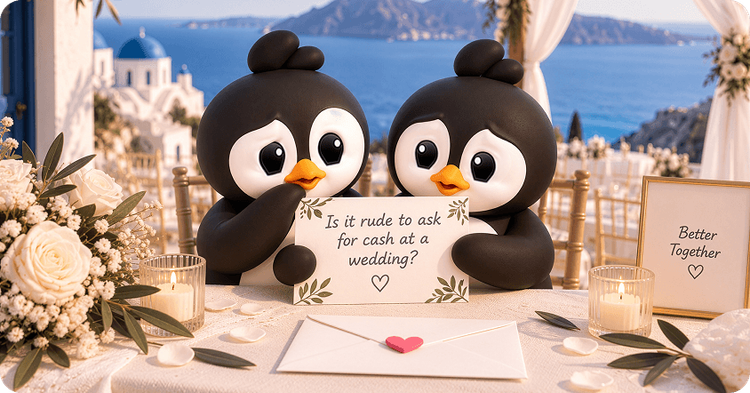
Short answer: no. But the discomfort is worth understanding. Once you see where it comes from, the whole thing stops feeling awkward.
Somewhere in your planning, someone will say it. A parent. A future in-law. Possibly a voice in your own head. "I'm not sure about asking for money. It feels a bit tacky."
It's a fair thing to feel. And it's not entirely baseless — there's a version of asking for cash at a wedding that does feel cold. A generic "we'd love money" with no context is a bit of a conversation-stopper.
But that's not really about cash. It's about vagueness. And once you understand the difference, the whole conversation changes.
A traditional gift has a story. You see it in a shop, you picture it in their home, you wrap it and give it. There's something to imagine.
A generic cash request doesn't have that. There's nothing to picture. Nothing to feel excited about giving. Just a number going into an account.
That's the problem — not the cash itself, but the absence of context around it.
The fix is simpler than most couples expect: tell guests what the money is for. Not in a long explanation, just a line. "We're saving for our honeymoon in Japan." "We're putting together a night in an overwater villa." "We'd love help towards our first home."
Give it a purpose and it stops being a cash request. It becomes something to be part of.
Here's something most couples discover only after the wedding: guests are relieved when you tell them what you want.
The alternatives are harder than they look. A gift list they might not be able to fill. A "no gifts please" line that most will feel guilty following. A cash envelope on the day with no idea whether the amount was right.
Most guests — including older ones — would rather know. The ones most likely to worry about cash gift etiquette are often the ones who give most generously once they can see what it's for.
"I was told about Collection Pot by a family member that used it. My wife and I wanted somewhere that friends could give a cash contribution for our honeymoon — it was easy to set up, and easy to contribute to."
Ernie, Trustpilot
Cash gifts at weddings have been the norm in much of Europe, Asia, and beyond for generations. In many cultures, envelopes of cash are the expected and entirely comfortable tradition.
The UK has been slower to shift — but it is shifting. Cash and contribution-based gift setups are now the most common alternative to a traditional gift list, and guests are increasingly familiar with them. The awkwardness, where it exists, is generational and fading fast.
The couples who feel most anxious about asking are often surprised to find their guests completely unbothered — or actively glad to be given a clear option.
The wording matters less than most couples think. What matters is being clear and giving guests a reason to feel good about giving.
On your invitation or wedding website:
"We're lucky enough to have everything we need for our home, so if you'd like to give a gift, we'd love contributions towards our honeymoon. Details at [link]."
Or shorter:
"Gifts: we'd love help towards our honeymoon — [link]."
You don't need a poem. You don't need to apologise. Straightforward is kinder than convoluted.
On your Pot itself:
Name what the money goes towards. Even a single line — "a week in the Greek islands" or "our first trip as Mr and Mrs" — gives guests something to picture. Specific moments at different price points (a dinner, a hotel night, a flight upgrade) work even better, because they let every guest find something that feels right for what they want to give.
Is it tacky to ask for money at a wedding?
No — and most guests will be relieved you did. The version that feels uncomfortable is a vague, context-free cash request. Asking for contributions towards something specific — your honeymoon, a home, an experience — feels like a real gift, not a transaction.
What do older guests think about cash wedding gifts?
Often more positively than couples expect. Many older guests have seen the alternatives — gift lists full of items that arrive duplicated or broken, or "no gifts" requests they felt awkward about — and appreciate being given a clear, easy option. A well-explained Pot is usually welcomed.
How do you word asking for cash on a wedding invitation?
Keep it simple. "We'd love contributions towards our honeymoon if you'd like to give a gift — details at [link]." No elaborate poems, no apologies. Brief and direct is better.
Do you have to explain what the money is for?
You don't have to — but it helps. Even a one-line description of what you're saving for changes how giving feels. Guests aren't handing over cash; they're helping fund something specific. That shift in framing makes a real difference.
Is a Honeymoon Pot the same as a cash registry?
Essentially, yes — a digital fund guests contribute to online. A Honeymoon Pot is focused on the trip specifically, and lets you add named moments at a range of prices so guests can choose what they'd like to fund. Free to create, no account needed to contribute.
A Honeymoon Pot is free to create, and guests don't need an account to chip in — just a link. You can keep it simple or add a wishlist of moments at different price points so guests can choose what they'd like to fund.
Related reading:
Honeymoon wishlist ideas: three styles to inspire yours

Jasmine Stone is a marketing manager with nearly ten years’ experience in digital fundraising and tech, creating campaigns that feel human rather than transactional. At Collection Pot, she focuses on content that makes group gifting easier and more joyful. When she is off duty, you will usually find her with her nose in a good book or exploring a new city.